
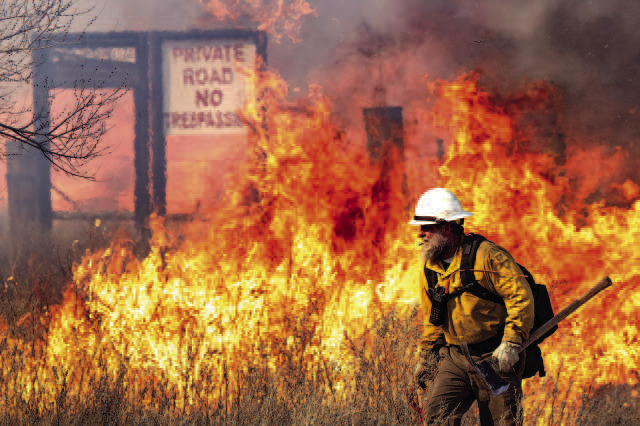
The National Interagency Fire Center (NIFC) has issued a significant wildland fire potential forecast for the next several months. Dry weather conditions, coupled with rapidly drying grasses and vegetation could contribute to large, fast-spreading wildfires, with wildfire risk conditions expected to peak in February and March.
The National Weather Service Climate Prediction Center had forecast a La Niña pattern for early 2026, bringing warmer and drier-than-normal conditions to much of Texas from January through March. These conditions were expected to increase wildfire risk during the dormant fire season.
“We are closely monitoring the increased likelihood of wildfire effective weather in Texas, including conditions associated with Southern Plains Wildfire Outbreaks,” said Luke Kanclerz, Texas A&M Forest Service Predictive Services Department head. “These outbreak events have historically resulted in multiple large, highimpact wildfires that can be difficult to contain and are an immediate threat to public and firefighter safety.”
Texas A&M Forest Service fire occurrence increased in the past seven days in the Cross Timbers and Rolling Plains Predictive Service Areas (PSA), with the Burns Lake Fire sweeping across 738 acres on Feb. 2 in Clay County.
The West Texas area located in the Southern Plains Serve Area. Texas A&M factors that drive the dormant wildfire season in Texas include grass fuel loading produced during the previous growing season; current and forecast drought conditions; temperature and precipitation trends, widespread, freeze cured grasses and timing of spring green up of grasses.; and the frequency of cold front passages and magnitude of windspeed in the pre- and post-frontal environment. The peak period for dormant fire season activity is mid-February through early April.
The largest wildfire on record in Texas is the Smokehouse Creak fire which burned more than one million acres as well as the 10th largest fire , the Windy Deuce, which burned 143, 302 acres – both occurred in the Texas Panhandle on Feb. 26, 2024. The Smokehouse Creek fire killed thousands of livestock, burned hundreds of homes and barns, fences, barn equipment and vehicles as well as taking several lives. As the state’s lead agency for wildfire response, Texas A&M Forest Service has established Wildland Fire Preparedness Levels through the year to ensure resource availability.
Level 1 – Minimal drought and normal fuel moisture allow local resources to suppress wildfires without issue. Fire activity is minimal.
Level 2 – Elevated fire danger observed in some regions of state. Additional resources may be requested to assist and aircraft may be staged in state for response.
Level 3 – Wildfire activity impacting several regions of state as a result of drought, dry vegetation or frequent fire weather events. Texas A&M Forest Service strategically positions personnel, equipment and aircraft in areas at risk. Additional resources, including those from other regions, agencies or states, may be necessary.
Level 4 – A very high volume of wildfires, including large fires and fires resistant to control, is reported daily across state. Fire environment will support increased wildfire activity and heavy commitment of state and local resources for long duration is likely required.
Level 5 – The highest level of wildland fire activity and indicates heavy resource commitment to fires locally and across the state. Conditions will support large complex wildfire incidents.
Maximum high temperatures this week are fore-cast to be 15-20 degrees above average, with Saturday being the warmest day of the week. Above normal temperatures contribute to increased fire potential by enhancing the speed of surface fuel drying, especially freeze-cured grasses and support increased ignition potential.
According to Texas A&M Forest Service, since 2005, wildfires that ignite under Southern Plains Wildfire Outbreak conditions represent only 3% of reported wildfires but have accounted for 49% of the total acres burned. Under these conditions, grasses dry rapidly and become highly flammable, where even a small spark can ignite a wildfire that spreads rapidly.
Nine out of 10 wildfires in Texas are human caused. Texas residents are encouraged to stay wildfire aware and to avoid outdoor activities that could spark wildfires during warm, dry and windy conditions. If a wildfire is observed, authorities should be contacted immediately to help save lives and property. Texans are urged to keep emergency kits stocked and an evacuation plan in the event a wildfire breaks out in their area.