The Levelland Fire Department (LFD) continues to emphasize compliance to fire codes. In order to ensure compliance and safety, the LFD conducts yearly inspections of businesses, including apartments, nursing homes, hotels and schools, to check for and eliminate fire hazards.
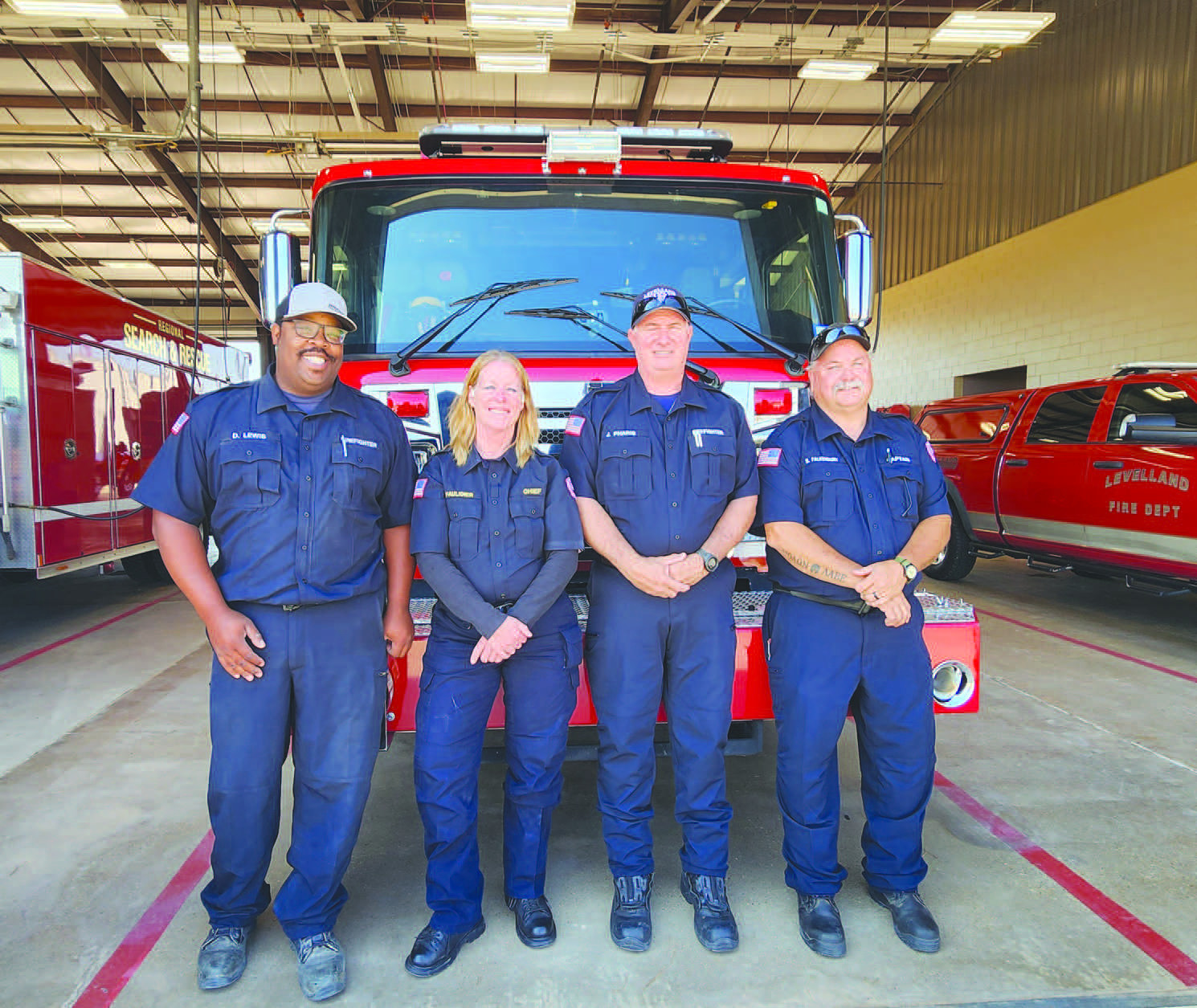
Fire Chief Patty Byars-Faulkner, Deputy Fire Marshal Jeff Pharis, Captain Brian Falkenbury and Firefighter Derrick Lewis shared what they look for in inspections and why the are necessary.
There are numerous reoccurring hazards that inspectors find while walking through buildings. For example, some common issues are leaving the breaker box open or unlabeled and storing things with the air conditioner in the HVAC closet.
“It’s the little things that people don’t even realize.” Falkenbury said.
People should avoid daisy chaining, which is attaching multiple power strips together. Plugging large items, such as appliances, into power strips is also not advised because power strips are not made to supply that much power. Appliances, such as microwaves and refridgerators, and other items that require a lot of electricity should be plugged directly into a wall.
Additionally, businesses should ensure they have working emergency lights and exit signs in their buildings. Lights should be able to stay on for 90 minutes after the power goes out. Glow in the dark stickers stuck on doors or walls are not ideal and therefore not advised.
Housekeeping and maintenance can also help prevent fires. For instance, cobwebs are extremely flammable and so should be cleared from spaces with electrical equipment. Maintaining ceiling tiles is important also as they provide a small barrier for containing fires.
It is also important to have maintained and accessible fire extinguishers. There should be no more than 75 feet in all directions between extinguishers and they should be maintained yearly. For those who do not know how to use a fire extinguisher, the LFD will do small classes upon request.
“A lot of people are afraid for no reason,” Byars-Faulkner said. “It’s just education, and we want you to know how to use it.”
Other fire and safety hazards that citizens should be aware of are missing plug covers, having heaters under desks, using plug in air fresheners and blocking or not properly marking fire prevention equipment, exits or road lanes.
“It’s all about safety,” Byars-Faulkner said. “I can’t quantify how many fires we’ve prevented because there’s nothing to count. We have no idea how many fires that we eliminated because we did a good inspection.”
To be certified to inspect buildings, LFD staff take a maximum of six months long online course, which they are required to pass with an 80%. They then take a test through the state, which they have to pass to be certified. Byars-Faulkner also does some on the job training for new inspectors. Currently, the LFD has six certified inspector with the seventh working through the process.
“It helps having a mentor to go out and show you things that you’re looking at rather than take a class that’s really all book work, but it’s not necessarily applicable to what you’re doing,” Byars-Faulkner said. “I’m taking them out, and we’re doing hands on stuff, and I think that that gets it into their brain a little more.”
Length of inspections depends on the size of the building, how many people are working on the inspection and what needs done. When notified of an upcoming inspection, business owners can do a selfinspection to take care of potential hazards beforehand. This will help official inspections to be shorter.
When an inspector goes in to inspect a business, they will not only point out hazards, but they will explain why those issues need to be fixed. This helps business owners to make informed decisions and better stay in compliance in the future.
Inspections may take longer when measurements are needed to determine the maximum occupancy of a building. Once the occupant load is determined, it will be posted on a sign which can then notify citizens that the building has been inspected that year.
The LFD will work with business owners to get buildings into compliance. As long as a person or business is willing to comply as quickly as possible, then enforcement is generally not necessary. However, if enforcement is necessary, then a citation may be issued.
This year, the LFD has conducted 77 inspections, 30 of which were last month.
“Part of our job fighting fires is to not have to fight that fire at all,” Pharis said. “And doing that is inspections.”
Another safety tool to help fire personnel access a building during emergencies is a Knox Box. Knox Boxes are small safes which are either attached to or embedded in the side of a building. They can hold keys to the particular building for use in an emergency.
Calling the box a small safe, Byars-Faulkner added the Knox Box is only accessible to the fire department. No other entities are able to access the boxes in any circumstance. There is also a required pin to be put in for the responding firefighter to access the key that opens the Knox Box attached to the property. Each pin is individual to the person who accesses the master key, and the computer records keep track of who opens the box and when.
Existing businesses are encouraged to order one, and they are available for residential buildings, gates and other applications as well. Upon request for a box, the company must receive approval from the fire chief for an order to be placed and a box installed.