
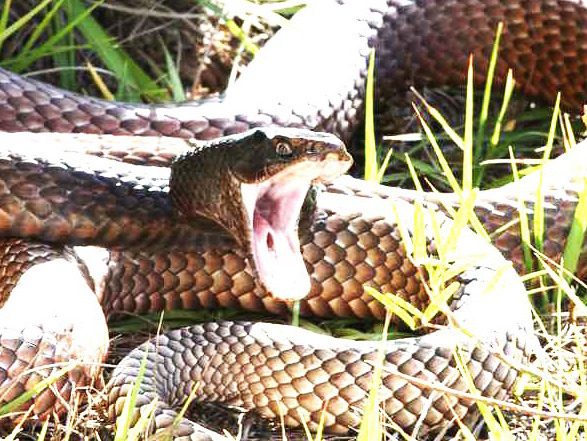
Texas is home to several species of venomous snakes; in addition to being able to identify the type of snake that bites a pet, being able to identify a snake bite itself is important in the event that a pet encounters a snake.
Dr. Christine Rutter, a clinical associate professor at the Texas A&M College of Veterinary Medicine and Biomedical Sciences, helps pet owners prepare for the potential risk of snake bites.
“Snakes like copperheads and rattlesnakes will leave a bitten animal with localized swelling and significant pain,” Rutter said. “It is also common for there to be a visible bite mark of 1-2 punctures that may trickle bloody fluid spontaneously.”
If the bite goes untreated, the surrounding tissue can begin to blacken and die in a process called necrosis. Venom also can inhibit normal blood clotting and/or cause neurologic signs like seizures and decreased alertness.
“Bites from other snake species, like the coral snake, are less obvious and sometimes cannot be identified,” Rutter said. “Envenomation can induce muscle weakness, irregular walking, an acute inability to swallow, and red blood cell destruction. Severe cases can cause weakness so severe that a pet may require help to breathe.”
While dogs are most bitten on the head and cats are most commonly bitten on the paws, a snake bite is possible in any location.
“Pets bitten on the head or face should have their collars removed so that swelling does not cause choking,” Rutter said.
The best course of action following a snakebite is to usher your pet to the veterinarian immediately.
“Owners should not attempt to capture or kill any snakes that tangle with pets,” Rutter said. “Photographs that include the head, the tail, and the pattern on the scales are the best thing to bring to your veterinarian. “There are no treatments that can be administered at home that will lessen the effects of snake venom, and many medications that owners have on hand can complicate envenomations,” Rutter said. “Snake bites are a true emergency.
Treatment is highly dependent on the type of snake and how much venom has been injected.
“Veterinarians are typically pretty good at knowing the clinical signs of envenomation by different types of snakes in their region,” Rutter said. “There are also social media sites that provide free expert snake identification. Don’t feel the need to bring the snake to the veterinary hospital — a picture will do nicely if you can acquire it safely.”
Assessments typically begin with a physical examination and running blood tests to determine if the animal needs to be given antivenom to counteract the reaction.
“The amount of antivenom required is dependent on how much venom the patient received.” Although it’s impossible to completely rid an outdoor environment of snakes, the best prevention is removing snake-friendly habitats from places pets frequent.
Some snake-friendly areas to remove or avoid include leaf litter, objects snakes can hide under, shrubs and tall grass, swampy areas and rodent-heavy areas.