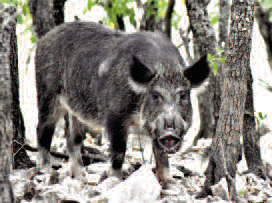
Feral hogs are a significant problem across Texas, including the South Plains, causing millions in crop damage through rooting and trampling, and competing with livestock and wildlife.
Feral hogs are a pervasive and costly invasive species in the South Plains, necessitating ongoing, aggressive management to protect agriculture and natural resources.
While prevalent in East, South, and Central Texas, they've spread statewide adapting to drier areas of West Texas, and are a major invasive species requiring constant lethal management (trapping, shooting) to control their vast numbers. Their extensive rooting and wallowing disrupt soil, damages infrastructure, and degrades natural areas, affecting both farms and parks.
In a 2019 study, the Texas Parks and Wildlife reported farmers and ranchers lost approximately $119 million each year to feral hogs. A 2016 study estimated 2.6 million feral hogs residing in Texas – the number is significantly higher now.
Texas alone reported $82 million in crop losses, the highest of any state, and about $85 million in livestock losses through predation, disease, vet costs and medical treatments.
Farmers in the region, such as around Lamesa, report thousands of dollars in losses from hogs destroying crops like peanuts overnight. Lubbock has also reported a significant increase in the feral hog population, whose extensive rooting and wallowing disrupt soil, damages infrastructure, and degrades natural areas, affecting both farms and parks.
Feral hogs are descendants of domestic pigs and Eurasian wild boars, rapidly reproducing and lacking natural predators in Texas. They prefer dense cover near water but can thrive in drier environments, utilizing brush, timber, and agricultural fields.
Feral hogs have the highest reproductive rate any ungulate, with a single female producing three litters of 4to 6 young every 14 months.
Feral hogs often attack livestock, preying on vulnerable animals like newborn calves, lambs, and piglets, and can cause significant financial losses through predation, disease transmission of brucellosis and pseudorabies, and damage to feed/pastures, impacting cattle, sheep, and goat producers heavily. They are opportunistic omnivores, eating roots, nuts and livestock, often killing young livestock by biting the head or neck. creating major threats to agriculture.
Experts with the Texas A&M Natural Resources Institute, NRI, are working to connect Texans with the resources and expertise necessary to address the growing challenge of feral hog management across the state’s rapidly changing landscape, particularly as they begin crossing into urban areas. With an estimated population of 2.6 million feral hogs, control of this invasive species has been a challenge across the state’s rural and agricultural landscapes. The management limitations that accompany suburban and metropolitan properties make controlling feral hogs or limiting their damage even more difficult.
Management and elimination of feral hogs can be challenging, with lethal control being the key. The most common methods of trapping, ground shooting, and aerial gunning are essential to manage the population, as non-lethal methods aren't enough. Control options include several monitored traps with cellular technology, firearms and archery both day and night, aerial gunning and toxins.
Hunting wild hogs in Texas is permitted yearround, with no season limits or bag restrictions, as they are an invasive species, allowing hunters to use various methords on private land without a license if they have permission, but public land requires a license and adherence to TPWD rules.
Texas aerial hog hunting is legal under specific Aerial Wildlife Management Permits (AWMP) for population control, requiring landowners or agents to file paperwork with TPWD, but it's distinct from recreational hunting and involves strict rules, permits, and coordination, allowing drones (day/night) and aircraft (day), with hunters using State IDs for documentation, not licenses.
Another way to eliminate feral hogs are hog-specific bait stations which use unique designs and baits to attract feral pigs while excluding other animals. In Texas, a license (Commercial, Noncommercial, or Private Applicator) from the state's Department of Agriculture is required to purchase and handle hog toxin baits, as they are considered statelimited- use pesticides, plus mandatory specific training and using approved feeders are also needed for safe and legal application.
Wild hogs generally avoid human presence, but caution should be used in areas with a high feral hog population, but hunters and experts warn these animals are ruthless and dangerous when cornered.
TPWD advises never approaching one and to back away slowly and quietly. If attacked, fight back and try to get to higher ground or a secure location.
For more information on wild hog management and safety, consult resources from organizations like the Texas Parks & Wildlife Department or the local extension office.