

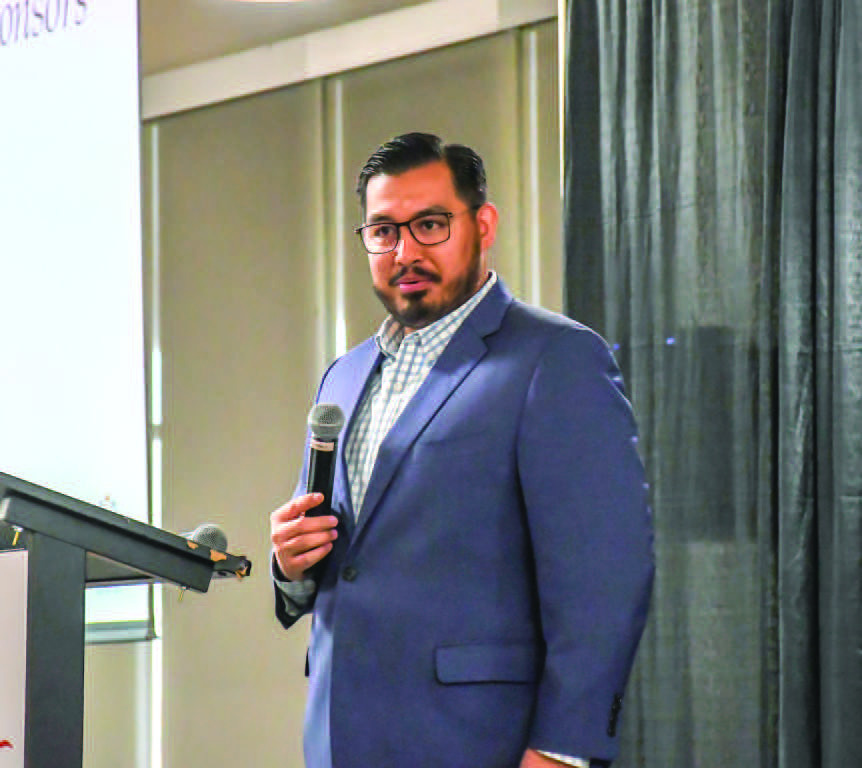
A keynote speaker at a Levelland Economic Development Corporation luncheon on Thursday spoke with attendees about the current economy.
Executive Director of LEDC, Justin Balderas introduced the keynote speaker for the luncheon, Dr. Ray Perryman.
Perryman spoke on the current economy, as well as the energy industry, on local, state and national levels.
He began his speech with the recent election and what he sees happening since it occurred.
He said when philosophies in the government branches change, things tend to move in certain directions, but not as much as what’s campaigned. Slogans and sayings during campaigns don’t encompass actual policy that’d have to go into effect.
“Who’s in the White House hasn’t made a great deal of difference in how the economy has performed,” Perryman said.
After this year’s general election, Perryman mentioned two things that happened in the economy: the stock market went up, bond market went down. Expectations of the economy drove these decisions, he said, some of them being expectations of taxes going down.
Tax rate will go down, he said, but not as much as campaigned, as the country’s deficit is just too big.
Perryman said the deficit isn’t a doomsday situation, but it’s getting to the point where people are paying more on the dollar on interest for federal debt.
According to fiscal data from the country’s treasury, national debt sits at about $36 million.
“It’s really become a very difficult thing to deal with,” Perryman said.
Perryman segued into tariffs and immigration and the misinformation surrounding them.
The notions that the tariffs aren’t paid by the U.S., and that the costs are made up of consumer inflation, aren’t true, he said.
Nonetheless, Perryman said he doesn’t think people will see a large amount of tariffs happening.
Regarding immigration, the idea of simply removing people from the country is impractical, and immigrants make up a large part of the agricultural workforce, he said.
“We couldn’t open the doors tomorrow,” Perryman said.
Border policies will be tougher, but ultimately, he said the idea connects back to the campaign message versus what is put into policy.
During Perryman’s speech, he spent time talking about energy and what the future looks like. Something people could see happening quickly is less regulations, including the removal of what he called “silly regulations.”
He said the ban on building new LNG plants was done for political reasons as a way to ban fossil fuels.
“If you believe, as I do, that there’s a climate crisis, the last thing you wanna do is get rid of LNG,” he said.
He said as LNG - liquified natural gas - is being used as an energy alternative to coal, it’s helping the environment.
Something else he expects alongside the removal of the policy is more ease in building pipelines.
Perryman said he thinks it shouldn’t take a law to build a pipeline, and currently, new pipelines are important as there isn’t enough capacity for sending gas.
As for types of energy, he said they need renewables to keep going, but oil and natural gas will continue to be developed, as they’ll still be needed in the industry.
However, he said energy policy also isn’t driven by whose presidential administration it is. Supply and demand will drive it.
Additionally, as the world tries to reduce carbon, demand will shift toward oil with lower carbon concentrations.
Another big thing happening in the economy is the lowering of interest rates after a period of inflation.
Perryman said this helps the housing and commercial real estate markets, as well as consumers in general.
However, if the tariff or immigration policies “gets too crazy”, rates will have to go the other direction.
Post-election projections for the nation that Perryman had included inflation staying under control and employment growth.
In the state, Perryman said the Site Selection’s Governor’s Cup - an award for a state bringing in the most new expansions, locations, investments - has been given to Texas 12 years in a row.
Specifically in the region, a trend is Lubbock moving west, bringing in new populations and merchants in the area.
With the way the populations are moving and the energy sector, Perryman said this area will see growth as well.
Perryman acknowledged that growth brings challenges. He references a water problem, as well as the need for more power.
That includes both the capacity to generate the power and transmission lines to move it where it’s needed, which he said will take some real investments.
However, the most important thing Perryman said they need to do is educate kids so they can go into the workforce of the future.
“They’re not simple challenges, but the good thing about economic prosperity is it gives you the resources that you need to meet those challenges with,” Perryman said.
Perryman answered questions from attendees, which included the potentially big futures of resources like microgrids, lithium and hydrogen.
During an answer, he said the notion that only green energy is getting money from the federal government is inaccurate.
However, the upcoming administration will move toward not subsidizing those industries. Perryman said the region is abundant in a lot of resources and has become important in energy production.
“What’s going to happen in the Permian Basin is going to be a major factor in the world in the future,” Perryman said.