
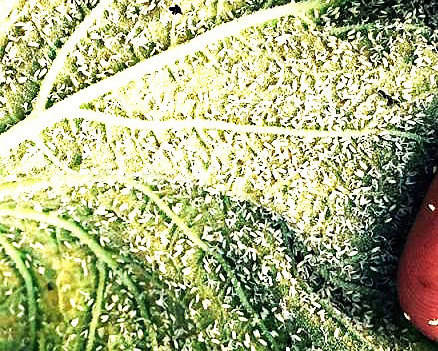
Although there are approximately 1,200 species of whiteflies worldwide, only a few species are of economic importance.
Most whitefly species have a narrow range of host plants, but the ones that are considered pests may feed on and damage many vegetable and field crops, greenhouse and nursery crops, and house plants.
The whitefly, also known as the sweet potato whitefly or the silverleaf whitefly, loves feasting on various vegetable crops including tomatoes, peppers, squash, cucumbers, beans, eggplant, watermelon, and cabbage. It also likes field crops such as potato, peanut, soybean, and cotton too.
Whiteflies are very small (about 1 mm in length), winged insects that appear as white dots on the underneath surface of the leaf, easily recognized as they take flight when leaves are rustled. They reduce plant vigor by sap feeding and allow growth of “sooty” mold on the honeydew exuded during feeding. Infested leaves also take on a chlorotic look in severe cases.
The insect transmits viruses, including Tomato Yellow Leaf Curl Virus (TYLCV), one of the most damaging pathogens of tomatoes and a serious threat to the tomato industry.
In a study, researchers used satellite imagery and machine learning to identify whitefly movement in vegetable crops in Southwest Florida in near real-time.
Whitefly populations and virus infections in crops were scouted during the four growing season study. They also determined how temperature, rainfall, and nearby crops affect virus spreads as well as how whiteflies move and spread viruses between fields.
“This study introduces a robust framework that integrates satellite-based crop identification with pest and disease risk profiling to support areawide pest control efforts,” said Clive Bock, ARS Research Plant Pathologist.
“If you can control the whitefly, then you can control the virus.”
The key findings include: -Satellite vegetable crop identification worked well, especially later in the season, with accuracy often above 80%.
-Whiteflies and TYLCV showed population clustering in foci, usually up to 1,750 meters, but later in the season sometimes up to 5,000 meters.
-Warm weather increases whitefly population numbers and resulting virus spread.
-Rainfall has little effect on whitefly populations and virus spread. -Nearby vegetable fields influence pest movement later in the season.
Whiteflies can move up to 9,000 meters between vegetable crops. -Both pests and viruses peak between February and April each year. To fight whiteflies, use a mix of yellow sticky traps to catch flying adults, prune heavily infested leaves, and spray the undersides of leaves with insecticidal soap or horticultural oil.
Other physical and mechanical controls include yellow sticky traps, pruning, and water spray, as well as organic and natural sprays, such as insecticidal soap, neem or horticultural oil, and vacuuming.