
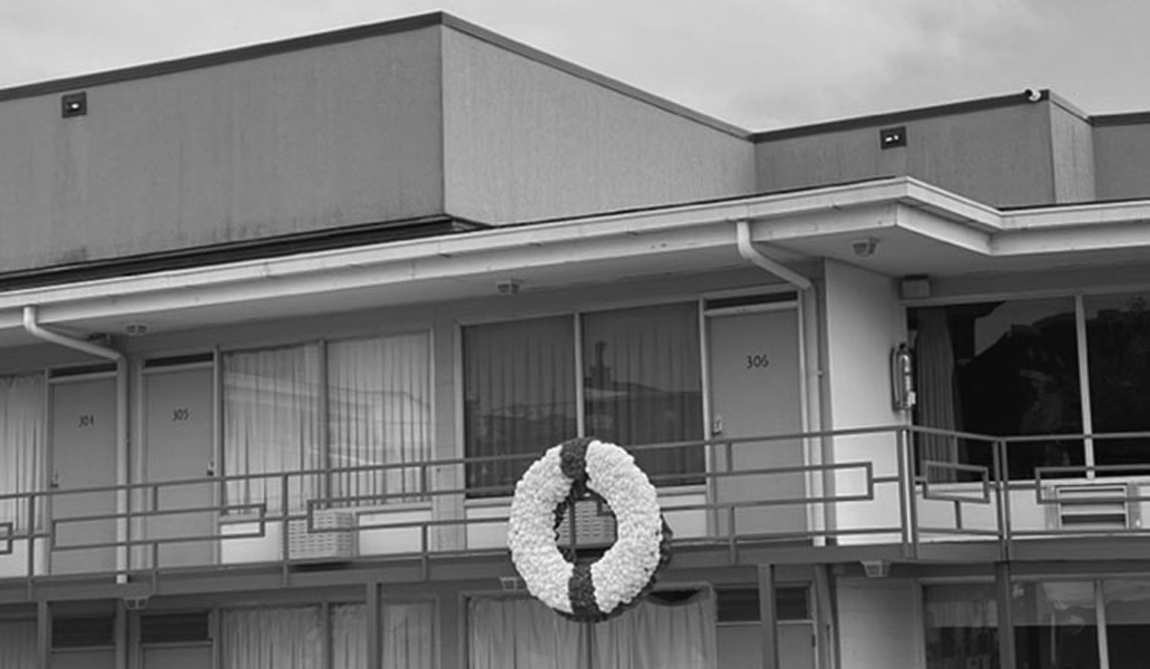
what would drive a person to come and reason, is the notion of sacrifice. While there in Memphis, staring at the Lorraine Hotel, trying to take myself back in time in my mind, I began reflecting on a time period that occurred almost sixty years ago. I stood there breathing in that Memphis air laced with the woodsy smell of Memphis barbeque. A smell that was free from the stench of decaying garbage because a man, a mortal man with righteous Godly values, spoke out with intelligent language. He spoke out when two sanitation workers; two human beings who happened to be black, were crushed to their death because there were not allowed to integrate with whites. In order to avoid the torrential rains, (as one movie suggests) these two black men while on break climbed into the rear of a sanitation truck. Because they were not allowed to integrate with the whites in the breakroom inside, they were forced to find shelter in whatever was readily available. They sat in the back of the compact department of a sanitation truck, which malfunctioned, pushing the men in, trapping them, and causing their death.
Dr. King sacrificed his reputation when he helped lead the effort in speaking out about unfair working conditions and treatment within the Memphis sanitation department. He shifted gears and took on the Poor People’s Campaign which appeared to take him off focus of what he started. He sacrificed his reputation. His views were challenged. His commitment to Civil Rights was questioned as he took on this venture to decry the senseless and tragic death of these two black sanitation workers and to speak out against unfair treatment, unfair pay, and unfair working conditions in the sanitation department.
It was there in Memphis in that same year, 1968, that Dr. King gave the ultimate sacrifice after his epic “Mountaintop Speech” at Mason Temple Church of God in Christ. He was shot to death on the balcony of the Lorraine hotel. It is conjectured that during the last years of his life that Dr. King faced opposition everywhere. Tavis Smiley in his book “Death of a King”, talks about the last year of Dr. King’s life. He talks about how Dr. King became unpopular in certain circles because of his expansion in his speeches to include his stance against poverty and economic injustices, and his antiwar rhetoric. He vehemently opposed the Vietnam War that President Lyndon Johnson had his hand of involvement. He, therefore, became unpopular with the President that earlier had invited him to come and reason. Dr. King sacrificed his name, his reputation, friendships, and connections, to speak out against social injustice.
He gives his mountaintop speech there at Mason Temple Church of God in Christ, a Pentecostal church. Smiley, in his book, says that everyone had turned their back on Dr. King, even members and affiliations of the Baptist Church. It is conjectured that Dr. King perhaps speaks at the historic Mason Temple only because those Pentecostal folk, those “holy rollers” as they were called, will accept in anybody.
Tavis Smiley goes on and he does not paint a pretty, historically euphoric picture of Dr. King’s final year. He speaks of the dark nuances of that final year. He speaks of the loneliness and depression that Dr. King undoubtedly endured. He speaks of one instance where Dr. King is so depressed so heavy and burdened with the weight of having to endure hateful treatment. He is mentally and emotionally depleted from speaking out, fighting, and advocating for social injustices for Black people and all people. Smiley tells how Dr. King is fully dressed one evening and is about to go out to whatever engagement was on schedule. He gets to the door and depression hits him. He is immobilized, and can’t move beyond the threshold of the door. He turns around goes back into his hotel room, and gets into bed fully dressed in his suit, tie, and shoes. He pulls the covers over his head and cries for hours inconsolably until he cries himself to sleep. Sacrifice!
This is a scene that is reminiscent of Jesus in Gethsemane. Jesus the ultimate sacrifice. Everybody has abandoned him, his friends, even the disciple brothers. The disciples can’t even stay awake to help him pray. He cries in the garden of Gethsemane! He prays alone to the Father. “Father if it is possible, let this cup pass from me!”
We should understand what’s in the cup. In the cup is separation from the Father, symbolically. In the cup are your sins and my sins! In the cup are agony and rejection. In the cup are pain and suffering. In the cup are the lashes He received on his back. The cup is the sacrifice of the servant.
Jesus knew that if he accepts the cup, every time the Father says to whomever, “ come” they could come. No matter what they had done. They could come and reason together with the Father. Though our sins be as scarlet, He can make them white as snow. Though they be red as crimson. They can become pure as wool.
Why does He do it? Why does Jesus do it? Why does He take the cup? He does it because of his love for you and me! So Jesus says, “nevertheless, ( sacrificially), not my will be done, but thy will be done.”
Dr. King must have read how Jesus was abandoned for he says, “The ultimate measure of a man is not where he stands in moments of comfort and convenience, but where he stands at times of challenge and controversy. The true neighbor will risk his position, his prestige, and even his life for the welfare of others.”
Dr. King seems to point us to Jesus. If Jesus Christ sacrificially offered himself for us, shall we not offer our service to others? If, instead of shifting responsibility, what if we take responsibility, and become second, putting others first? What if we accepted the invitation and answered the call to come and reason together? I think we would discover the grace of God and the true depths of His love for us all that teaches us how to love one another.