
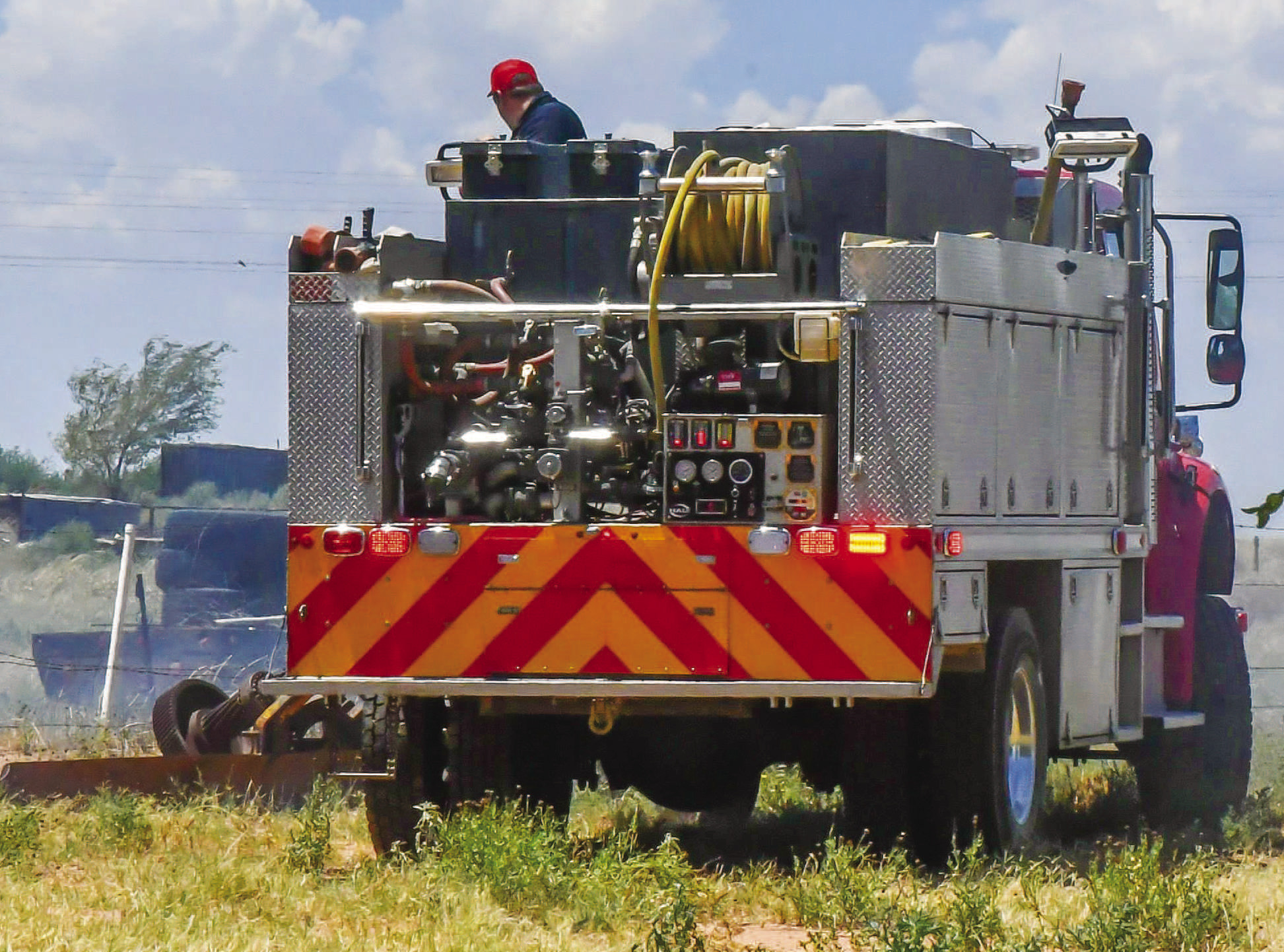
Extreme temperatures and lack of humidity are big factors when it comes to grass and wild fires in the West Texas area.
Hockley County and surrounding counties have received short periods of rainfall throughout the summer months causing heavy fuel loading.
Levelland-Hockley County Emergency Management Coordinator Cole Kirkland explained that various factors play into grass fires being created.
Examples could be low hanging chains on trailers causing sparks on roadways, thrown out cigarette buds, power lines or equipment that shorts and causes sparks.
The Texas A&M Forest Service states people and their activities cause more than 90% of all wildfires in Texas. The largest number of human-caused wildfires is a result of careless debris burning. Other causes of wildfires include sparks from welding and grinding equipment, carelessly discarded smoking materials, vehicles’ exhaust systems and arson.
Compliance with burn bans reduces unsafe debris burning; but a burn ban does not have to be in effect for outdoor burning to be illegal. Negligently allowing fire to escape onto someone else’s property is a class c misdemeanor, punishable by a fine up to $500.
The forest service has offered tips for debris burning that community members are encouraged to follow: - check for local bans on outdoor burning; - keep informed of grassfire danger levels; - avoid burning trash, leaves and brush on dry, windy days; - check to see if weather changes are expected. Postpone outdoor burning if shifts in wind direction, high winds or wind gusts are in the forecast; -before doing any burning, establish wide control lines down to bare mineral soil at least five feet wide around any burn barrels and even wider around brush piles and other piled debris to be burned. The larger the debris pile, the wider the control line needed to ensure burning materials won’t be blown or roll off the pile into vegetation outside the line; - burn household trash only in a burn barrel or other trash container equipped with a screen or metal grid to keep burning material contained; - never attempt to burn aerosol cans; heated cans will explode. Flying material may cause injuries and the explosion may scatter burning material into nearby vegetation and cause a wildfire; - stay with outdoor fires until they are completely out; and - keep water and hand tools ready in case your fire should attempt to spread.
For homeowners, it is suggested to consider improving access for emergency responders.
A quick response to a wildfire is critical for saving a home. Firefighting personnel must be able to quickly locate and safely travel to the home. Emergency responders may not be familiar with the entirety of the community, so highly visible signs are important to help them find their way.
Community members must also remember that fire trucks are larger and heavier than normal vehicles, it is essential that all access lanes are wide enough, have proper clearance and can support the weight of fire vehicles.
A few tips to help improve access to different properties are as follows: - street signs should be at least three inches tall, words on a contrasting color background, made of reflective material, made of fire resistant material and visible from both directions; - street addresses should be labeled, having different names and numbers; - the home should have its own house number and be in numerical order along with the street; - if the home is set back from the street, post the address at the end of the driveway where it is visible from the street; - if multiple homes share a single driveway, post all addresses at the entrance from the street and at each appropriate intersection along the driveway.
- single lane one-way roads should have turnout spaces at regular intervals to allow emergency vehicles access and cars to pass; - design a minimum of two primary roads in every development; - public and private streets should be a minimum of 10-feet wide, in order to allow two traffic lanes; - curves and intersections should be wide enough for large fire equipment to easily pass and turn;
- streets and bridges should be built to withstand at least 40,000 pounds; - roads and driveways must not be too steep or have sharp curves; - dead-end streets and long driveways should have a turnaround area designed as a T or circle large enough to allow emergency equipment to turn around.
Whether individuals live in a community with poorly labeled streets or at the end of a long dead end road, making sure emergency personnel can quickly locate and get to a home can increase the residence’s chance of survival during a grassfire.
Currently, 173 counties are under a burn ban as of August 8. Yoakum, Cochran, Bailey, Lamb Hale and Castro County are implementing burn bans.
County burn ban orders are established by county judges and, or county commissioners’ courts.
Hockley, Lubbock, Terry and Lyn County are currently not under burn bans.
Kirkland explained that a burn ban for Hockley County does not seem likely as a majority of Hockley County community members adhere to safe practices when burning debris.
The forest service currently has a large portion of West Texas and the Panhandle area under a moderate fire danger rating from August 8 through August 10. Moving further east of Lubbock, the area begins to increase in danger rating with high to very high ratings.
Levelland-Hockley County Emergency Management is urging residents and business owners to register for weather related and emergency notifications to stay informed and alerted in case of emergencies.
Residents are encouraged to go to RUAWARE.US to register for Hockley County Alerts. Business Owners in Hockley County can go to https://r.iinfo.com/hockleycobizcontact for business alerts.
Also, individuals are encouraged to check their wireless device has the “emergency alerts by location” turned on. That will allow notifications to come through similar to the amber alerts but are initiated locally for emergency situations such as tornado warning or dynamic police incidents.
Individuals should not assume that getting amber alerts to their phone their settings are correct for the notification; people will have to allow location alerts.
What location alert means is it will send the message based off geographical boundaries; the alert can be isolated to a specific area for only those within the preset boundary to receive the notification. This is a voluntary activation as amber alert system is not voluntary.
All alerts through this system come from local officials; never spam, solicitation calls, text messages or emails. All of the text messages will come from the same number so it can be saved in contacts to be easily recognized.
The phone calls will come through with the office of emergency management number 806-568-5487 so it can be saved and easily recognizable as well. In addition to storm season getting into full-swing, grass fires are expected to be of concern with the large amount of fuel scattered across the county and west Texas.