
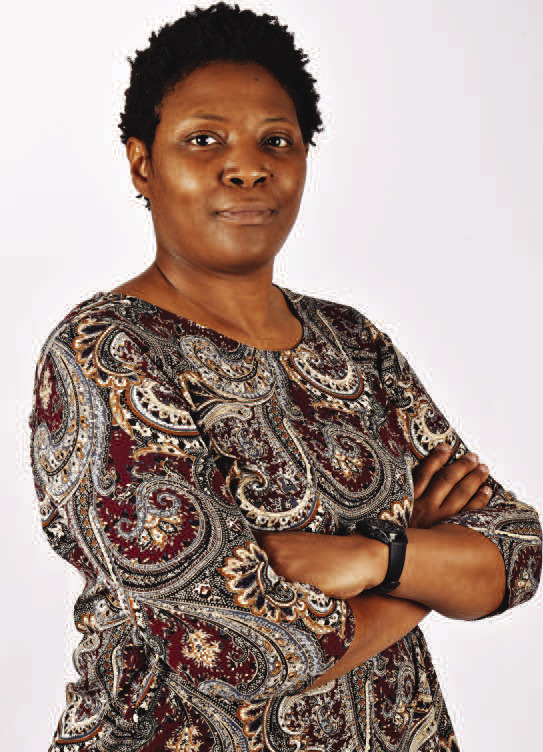
For Dr. Sheyleah V. Harris-Plant, being a faculty member at South Plains College is an opportunity to help students succeed in their future endeavors in and outside the classroom.
Harris-Plant, professor of mathematics and chairperson of SPC’s Mathematics, Engineering and Computer Science Department, received the Faculty Excellence Award at the college’s Spring 2024 morning commencement ceremony on May 10 in the Texan Dome. Every year, the award recognizes a faculty member for exemplary work in the classroom, service to the college and service to the community.
Harris-Plant has been a teacher for more than two decades and has spent most of her teaching career transforming the lives of SPC students in the college’s Mathematics, Engineering and Computer Science Department. She said every student has a dream of success they want to fulfill someday, and they will need support in executing this dream.
“Humans tend to see the big goal but don’t understand the small steps needed to get to the big goal,” she said. “My job is to help students see the small steps, show them how to achieve small goals and communicate that each small goal is a step closer to the big goal and their dream.”
Harris-Plant started her college education at Enterprise State Community College in Enterprise, Alabama and later obtained an Associate of Arts with an emphasis in math. After receiving her Bachelor of Arts in Math from Huntingdon College in Montgomery, Alabama, she traveled to Lubbock to earn her Master of Science in Math and Doctor of Philosophy in Higher Education from Texas Tech University.
Despite being finished with her college education, Harris-Plant never stops learning. She constantly develops her teaching and leadership skills to ensure she can set her students up for success. She is certified in Blackboard Ultra, has served as a 2022 Title V Leadership Academy fellow and has attended multiple professional development workshops regarding quality teaching practices and tools.
Harris-Plant also helped the SPC Math Department faculty create a math foundations class with built-in study skills and required tutoring for Adult Basic Education-level students and develop a year-long college algebra class for online dual credit students.
In addition to her teaching and chairperson duties at SPC, Harris-Plant has served on the college’s Academic Council, Building and Grounds Committee and Evaluation Committee. She also helps recruit students for the Mathematics, Engineering and Computer Science Department at college fairs and attends transfer summits with other institutions. Outside of SPC, she dedicates time to tutoring Lubbock middle school students in math.
Harris-Plant understands math can be difficult for students. Therefore, she has provided multiple opportunities for her students to learn from their mistakes and grow.
“I try to find ways to help students succeed by providing some tools to help them learn and eliminating any excuse for why they could not be successful,” she said.
Creating a motivational syllabus that encourages students to read and remember class policies and dedicating class time to active learning are just a few of the approaches Harris-Plant has implemented. She also utilizes a flipped classroom model to let students personalize the speed of the lectures.
“Some students need material presented slower and repeated, which cannot be accommodated in a classroom limited by time,” she said regarding the use of a flipped classroom model.
Another tool Harris-Plant uses to help students is Microsoft OneNote. These digital notebooks let her class access notes from in-person and virtual office visits and math problems covered during the lectures.
Regarding active learning, Harris-Plant said she works out half of the math examples in lecture videos and encourages students to attempt the rest. To aid in this process, she structures her lecture notes to match the lecture videos.
Via Gradescope—another resource Harris-Plant uses to grade and keep student assignments anonymous—students can access her detailed feedback with the math notation.
“I provide the key with solutions worked out step by step to every practice problem, and some of the more challenging practice problems have videos for students to watch me work it out at their own pace,” she said.
In addition to providing solutions to every graded assignment after the due date, Harris-Plant also requires her students to reflect on their study habits every week and learn from their mistakes. Through this process, students can see the improvements they need to make to excel in the class.
“I do everything I can to show and teach the habits that can be altered to achieve success,” she said. “I try to communicate to each student I interact with that I am working with them to achieve their goal, not trying to stand in their way and prevent them from achieving it.”
Teaching allows Harris-Plant to help students succeed in any aspect of their lives, not just education.
“I view every interaction with our students as a teaching opportunity,” she said. “The opportunity may be over life skills, how to cope with stress, how to solve a quadratic equation or how to graduate and transfer to another institution, but each interaction is an opportunity to improve each student’s life.”