
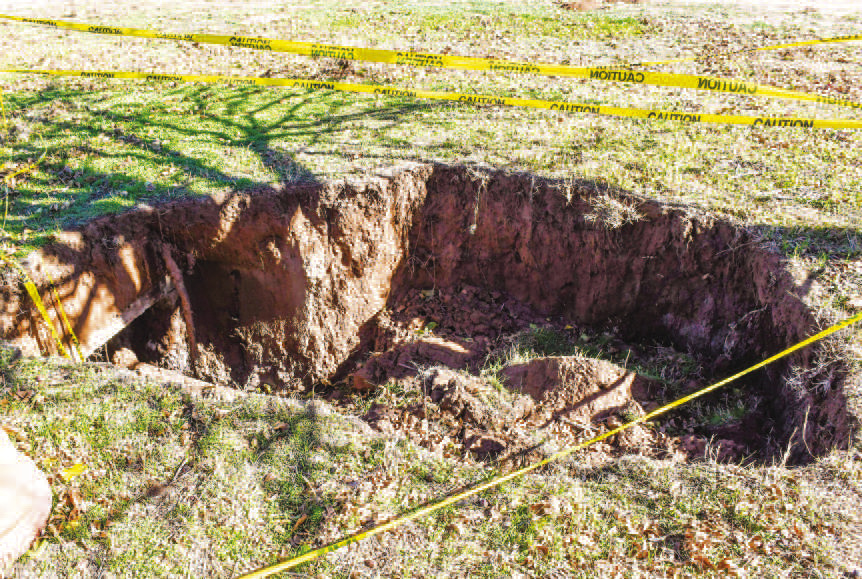
The the last heavy rain in the area caused a Whitharral yard to cave-in, the owner of the property, John Dea, blocked the underground area with caution tape.
Dea said he knew of others in the area with a similar issue, and the frequency was confirmed by the worker there to fill up the underground area Dea did not know was on his property.
“In West Texas, here in our area – Hockley County, Lubbock County – we get multiple calls every month for cave-ins,” said Ty DeFoor, owner of D4 Roofing.
DeFoor said these sinkholes can either be geologic or from human activity. For the Whitharral hole, the cause was human activity, following the trend of calls from the area.
“Sinkholes happen all the time, but like I said, nine times out of 10, they’re generally human activity related,” DeFoor said.
The cause can be found with a site assessment. With DeFoor’s company, he said the visit includes checking for dangerous shoring, the depth of the hole and if it is prone to falling any deeper.
“With John, it’s an easy fix,” DeFoor said. “We come out, we excavate the hole, find out the true depth, remove all existing materials and fill in the hole and make sure it’s safe.”
DeFoor said a yard could give signs before it caves in, such as cracks or waves in the ground.
Property buyers can also have a septic inspection done if the property is older, he said.
The issue should be addressed before any other activity takes place on the area, like yard play, landscaping and building, he said.
“Anything like that, obviously, the topsoil needs to be inspected,” DeFoor said.
In Dea’s case, he said he was worried about people that were around the sinkhole, such as lawn crew driving over the spot and local community members.
“So basically, we were glad to go check out John’s issue, because he was like, ‘I don’t know what this is, it’s just a big, deep hole that I’m real concerned about,’” DeFoor said. “You know, neighbors dogs, cats falling into it.”
However, DeFoor said just falling into the hole is not usually the danger posed by a cave-in.
Gas and electric lines can be run into when the surface falls in, he said. In Dea’s case, DeFoor said a PVC pipe was broken, likely after the concrete above it caved in.
“We can have gas leaks from cave-ins, we can have electrical disruptions,” DeFoor said. “Many issues can arise just off of a cavein in itself other than an immediate human danger, like you’re walking along and you fall into a sinkhole.”
However, if a resident notices the signs of topsoil giving way, DeFoor said the issue can be addressed before something catastrophic happens.
He said the main thing to know when a sinkhole happens is who to call, and he recommended that residents start with a storm shelter company so an initial site inspection can be done.
“We can advise the customer, from that point, the direction they need to go just to keep them safe, their family safe,” DeFoor said.